| Quick Answer: Honey bees are fuzzy, golden-brown, and important pollinators that mostly want to be left alone; wasps (like paper wasps, yellowjackets, and hornets) are smooth, slender, and can sting repeatedly. The response differs: in Florida, a honey bee colony nesting at your home should be removed by a registered beekeeper or licensed pest professional, while a problem wasp nest is treated and removed. Don’t disturb either yourself. |
| Feature | Honey bees | Wasps (paper wasp, yellowjacket, hornet) |
|---|---|---|
| Body | Fuzzy, rounded, golden-brown | Smooth, slender, often bright-marked |
| Role | Key pollinators | Predators; minor pollinators |
| Nest | Wax combs; cavities, walls, hollow trees | Paper nests under eaves, in ground, in voids |
| Stinging | Sting once (barbed stinger) | Can sting repeatedly |
| Right response | Beekeeper relocation or licensed PCO | Professional nest treatment/removal |
Why telling them apart matters
Honey bees and wasps look similar enough at a glance to be confused, but the right response is very different — so identifying which you have is the first step. Honey bees are valuable pollinators, and in Florida a feral colony nesting at a home is typically handled by relocation through a registered beekeeper or by a licensed pest control operator, rather than casual extermination. Wasps that build a threatening nest near living space are treated and removed. Getting the identification right means the bees that should be saved are, and the wasps that pose a hazard are handled appropriately.
How to tell a honey bee from a wasp
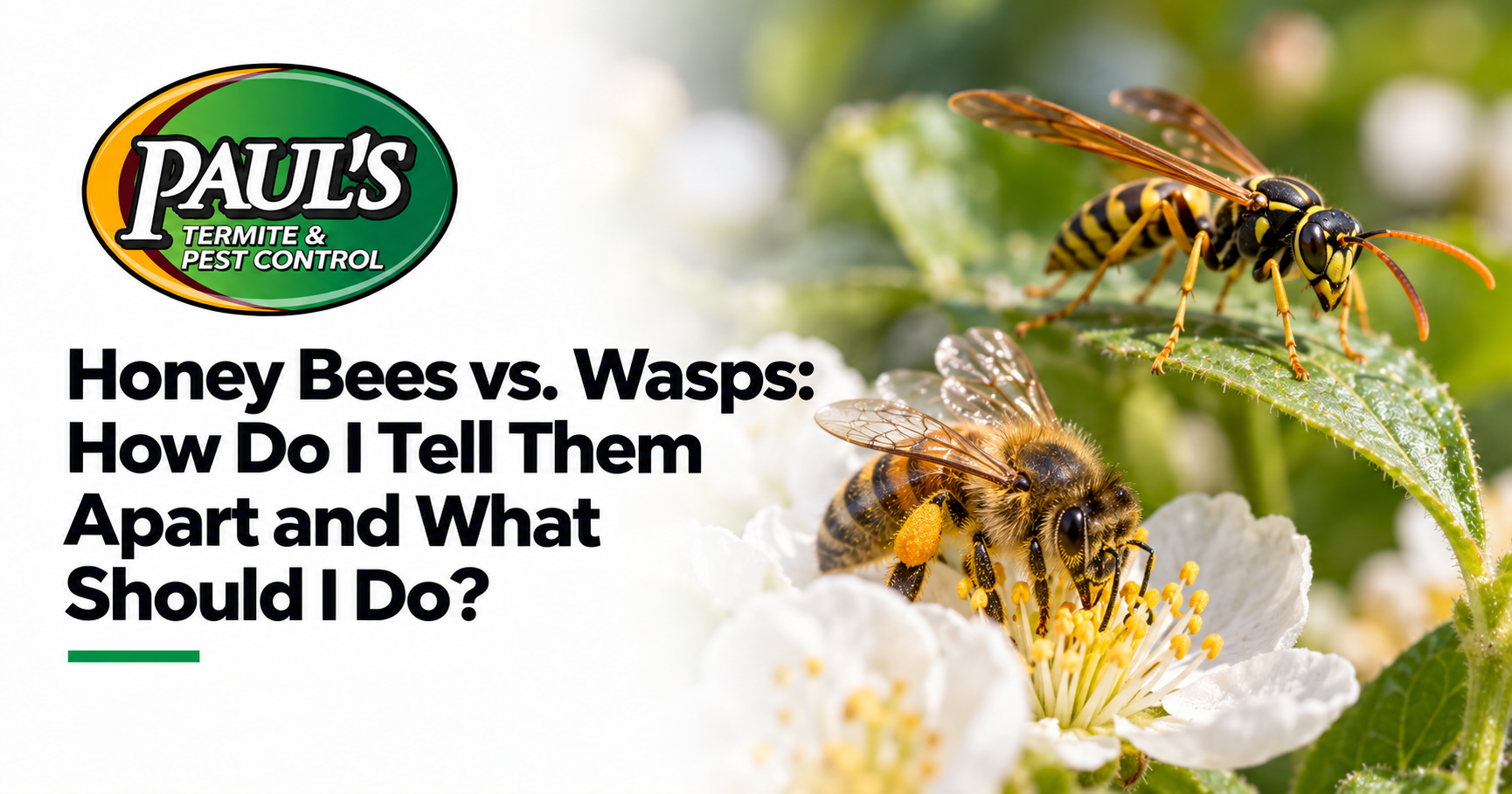
The quickest visual cue is texture and shape. Honey bees are fuzzy and rounded, golden-brown with darker bands, and look a little “hairy,” which helps them carry pollen. Wasps — paper wasps, yellowjackets, and hornets — are smooth, slender, and often more brightly or sharply marked, with a noticeably narrow waist. Behavior helps too: honey bees are generally focused on flowers and not aggressive away from the hive, while wasps are more likely to be scavenging around food and drinks or aggressively defending a nest. If you can safely note the body texture and the nest type, you can usually tell them apart.
Honey bees: why you don’t just exterminate them
Honey bees are essential pollinators, and Florida’s guidance reflects that. The state recommends that nuisance honey bees nesting outside a managed hive be removed alive by a registered beekeeper or handled by a licensed pest control operator, rather than left to chance — guidance summarized on the FDACS page on honey bee removal or eradication in Florida. There is also a safety dimension: because of Africanized (“African”) honey bees in Florida, any feral colony near people should be evaluated and handled by professionals, never disturbed by a homeowner. Spraying a honey bee colony in a wall yourself can be both harmful and ineffective.
Wasps: when they’re a problem
Wasps play a useful role outdoors as predators of other insects, and a nest far from foot traffic can often be left alone. They become a problem when a nest is built where people pass — under eaves and doorways, on play structures, in the ground along a walkway, or inside a wall void. Unlike honey bees, wasps can sting repeatedly, and some, like yellowjackets, defend their nests aggressively. A nest near living space, or any nest for someone with a sting allergy, is worth professional removal. Ground-nesting yellowjackets are a particular summer hazard in North Florida yards, because a nest can be hidden in the lawn or a landscape bed until a mower or footstep sets off the whole colony — which is exactly the kind of situation best handled by a professional rather than discovered the hard way.
What you should — and shouldn’t — do
Whichever insect you have, the safe approach is hands-off until it is identified and handled correctly. A few rules cover most situations:
- Don’t swat at, spray, or knock down a nest yourself — that provokes defensive stinging.
- Keep people and pets away from an active nest, especially in the ground or in a wall.
- If you suspect honey bees, treat them as bees to be relocated, not exterminated, and call a professional.
- If anyone has a known sting allergy, keep well clear and arrange professional removal.
How professional handling works
For wasps, hornets, and yellowjackets, Paul’s locates and treats the nest and removes it, then advises on preventing new nests — handled through its stinging insect control service. For honey bees, the right path is relocation by a registered beekeeper or appropriate professional handling, consistent with state guidance. Either way, professional removal avoids the danger of a do-it-yourself attempt and makes sure the situation is resolved safely. Paul’s serves stinging-insect calls across the communities on its areas we service page.
What about the other stinging look-alikes?
Honey bees and wasps are the two most common categories, but North Florida has a few other stingers worth recognizing, since the right response varies. Bumble bees are large, very fuzzy, and important pollinators; they nest in the ground or cavities, are generally docile, and are best left alone unless a nest is in a high-traffic spot. Carpenter bees look similar but have a shiny black abdomen and bore round holes in wood. Among the wasps, paper wasps build the familiar open, umbrella-shaped combs under eaves; yellowjackets often nest in the ground or in voids and are the most aggressive defenders; and hornets build large enclosed paper nests. Mud daubers, by contrast, build small mud tubes and are solitary and non-aggressive. The practical theme across all of them is the same: pollinators like honey bees and bumble bees deserve protection and, when nesting in a problem spot, relocation or careful professional handling, while aggressive nesters near living space are candidates for professional removal. If you are not sure which stinger you have, a quick identification prevents both needless harm to beneficial bees and the risk of provoking an aggressive nest.
Frequently Asked Questions
How do I tell a honey bee from a wasp?
Honey bees are fuzzy, rounded, and golden-brown; wasps are smooth, slender, and brightly marked with a narrow waist. Nest type helps too — wax comb (bees) vs. paper nest or ground nest (wasps).
Can I just spray a honey bee colony in my wall?
No. Florida guidance is to relocate nuisance honey bees through a registered beekeeper or have a licensed professional handle them. Spraying can be harmful, ineffective, and is discouraged.
Are wasps good for anything?
Yes — wasps prey on other insects, so a nest far from foot traffic can often be left alone. The concern is a nest near living space or for anyone with a sting allergy.
Why shouldn’t I remove a nest myself?
Disturbing a nest provokes defensive stinging, and wasps can sting repeatedly. Professional removal is safer, especially for ground nests, wall voids, and allergy concerns.
Do you serve my area?
Yes — Paul’s serves the Tallahassee and Jacksonville / Orange Park metros. For a free quote, call Tallahassee: 850-222-6808 / Jacksonville & Orange Park: 904-567-8307.
Key takeaways
- Honey bees are fuzzy pollinators that sting once; wasps are smooth, can sting repeatedly, and may defend nests aggressively.
- In Florida, honey bee colonies are relocated by a registered beekeeper or handled by a licensed professional — not casually exterminated; problem wasp nests are treated and removed.
- Don’t disturb either yourself — call 850-222-6808 for safe handling.